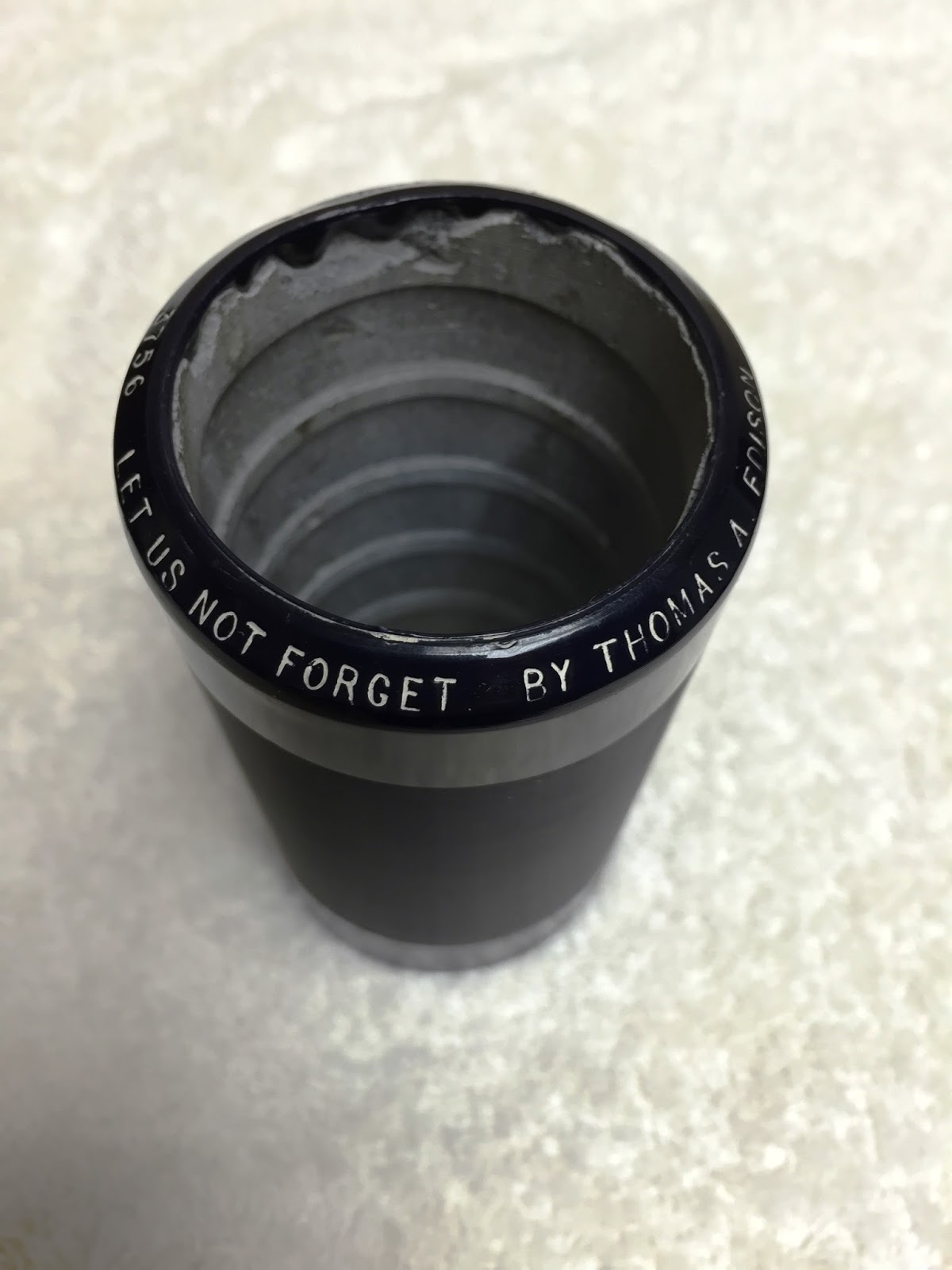
This week's installment is a February 1914 of My Heart at Thy Sweet Voice, from Camille Saint-Saëns Opera Samson and Delilah, as performed by contralto Mary Jordan (1879-1961). (Samson et Dalila. Mon cœur s'ouvre à ta voix) Cylinder number 2158: Edison Blue Amberol
Something that struck me right away about the recording was that Mary Jordan made the recording while Camille Saint-Saëns (1835-1921) was still living. What an amazing time to be alive. I wonder if he heard it? What must it have been like to hear recordings of your works in the early days of recording?
It is fairly well documented that Thomas Edison did not tolerate vibrato or tremolo either in voice or instrument. This peculiar musical taste of his, it is conjectured, was due to his hearing loss.
Neil Baldwin, in his book, Edison, Inventing the Century, recounts the story of Edison’s dislike of complicated music:
“Edison [was] in the business to find the best mechanical way to “establish music on a scientific basis.” Along with a more finely honed consumer product, he likewise sought to eliminate the intervention of the singer’s dramatic personality, expressed through vocal devices like vibrato; he believed these “false notes” were symptomatic of “interpretative” music and its concomitantly misleading and superfluous nuances and subtleties—which, of course, he could not truly discern or appreciate.
“Instead, Edison sought clear diction, what he called “straight” tone: just plain, unadorned notes.”
When a famous violinist was playing for Edison, the violinist quickly realized the sort of sound Edison was looking for and thus "...he drew a dead sound, the worst kind possible, utterly devoid of vibrato. "That's great! That's great!" Edison said."
True to form, in Mary Jordan's recording of this aria, her vibrato is slow, and the solo violin passages are devoid of any trace of vibrato... just a straight tone.
Not much is known about Mary Jordan, apart from her career with Edison and a note in the Edison Amberol Monthly vol 11 about her headlining at the Century Theatre in New York.
I was able to find this picture of Mary Jordan performing at the Century Theatre:

Also, the pictures below of her name in print in the Edison Amberol Monthly, which was published for sellers of phonographs:

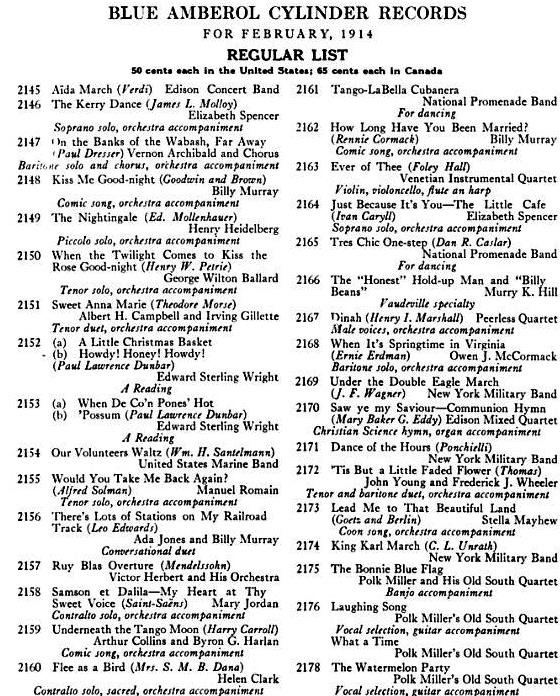
Finally, a picture of her name in print next to the cylinder of "My Heart at Thy Sweet Voice" Edison Cylinder 2158:
My Heart At Thy Sweet Voice Lyrics
My heart at they sweet voice
Swift unfolds like a flower,
When the dawn first is showing.
Swift unfolds like a flower,
When the dawn first is showing.
But Oh! to stop my tears
Thou has it in thy power,
One word more, love be stowing.
Thou has it in thy power,
One word more, love be stowing.
To thy Delilah gay
Thou returnest for alway!
Repeat they wooing tender,
All the vows once more tell;
Those sweet vows lov’d so well!
Thou returnest for alway!
Repeat they wooing tender,
All the vows once more tell;
Those sweet vows lov’d so well!
Chorus
Ah! come list to my fond wooing!
‘Tis with ardor my heart imbuing!
Listen unto my wooing, Listen unto my wooing
Ah! ‘Tis with ardor my heart imbuing!
‘Tis with ardor my heart imbuing!
Listen unto my wooing, Listen unto my wooing
Ah! ‘Tis with ardor my heart imbuing!
Mon cœur s'ouvre à ta voix
Mon cœur s'ouvre à ta voix,
comme s'ouvrent les fleurs
aux baisers de l'aurore!
Mais, ô mon bienaimé,
pour mieux sécher mes pleurs,
que ta voix parle encore!
Dis-moi qu'à Dalila
tu reviens pour jamais.
Redis à ma tendresse
les serments d'autrefois,
ces serments que j'aimais!
|: Ah! réponds à ma tendresse!
Verse-moi, verse-moi l'ivresse! :
Ainsi qu'on voit des blés
les épis onduler
sous la brise légère,
ainsi frémit mon coeur,
prêt à se consoler,
à ta voix qui m'est chère!
La flèche est moins rapide
à porter le trépas,
que ne l'est ton amante
à voler dans tes bras!
|: Ah! réponds à ma tendresse!
Verse-moi, verse-moi l'ivresse!
les épis onduler
sous la brise légère,
ainsi frémit mon coeur,
prêt à se consoler,
à ta voix qui m'est chère!
La flèche est moins rapide
à porter le trépas,
que ne l'est ton amante
à voler dans tes bras!
|: Ah! réponds à ma tendresse!
Verse-moi, verse-moi l'ivresse!