Showing posts with label organ. Show all posts

Thursday, November 5, 2015

A Pipe Organ Desk!

I recently created a board on Pinterest called Random Old Organ Pipes.  

I got the idea from a picture I'd seen of a birdhouse made out of two old wooden flute pipes. (Whether or not making a birdhouse from an organ pipe qualifies as a travesty is a topic for later discussion...)  Well, it's surprising what people have dreamed up.  An organ pipe shelf.  An organ pipe knife holder.  An organ pipe ribbon rack.  Organ pipe benches.  And my favorite, the aforementioned organ pipe birdhouse.

But it was the Kagen Sounds pipe organ desk that really grabbed my attention, for, not only is it beautifully crafted desk with organ pipes about; it's also a sort of puzzle!  Master wood worker and designer Kagen Sound of Denver, Colorado, has created this pipe organ desk with the most beautiful woods, unparalleled craftsmanship, and intrigue.

Kagen's specialty is secret boxes, and is a recognized member of the world's only guild of secret box makers. 

Pipe organs, as we all know, are the epitome of a "secret box" with all of their pipework, windways, windchests, mechanical actions, wiring, and bellows, reservoirs, and blowers.  So what a perfect combination, to build an organ that makes noise as one opens and closes the desk drawers.

Do you remember an episode of Scooby Doo where the team finds a note on an organ that says "FEED the organ and watch the floor?"  Its always stuck with me, that Velma (who else?) figured out that FEED meant to play the notes F, E, E, D on the organ.  Sure enough a trap door opened in the floor and Shaggy, Scooby, et. al were able to escape.

In much the same way (with apologies to Kagen Sound), the pipe organ desk--when *FED* the appropriate combination of drawers opening and closing--opens up to reveal secret compartments.  One can even play tunes and solve more puzzles contained within the larger drawers! 


 The amazing craftsmanship of the Pipe Organ Desk can be seen in the pictures on the site.  I've chosen a few that I found the most fascinating.

"Adjusting these pegs on the back of the memory board changes the tune it reads. The dark pegs represent the notes of the song."  (Picture and Text from Kagen Sound Website)


 Wooden air connectors inside the desk. (Picture and Text from Kagen Sound Website)


The pneumatic memory board and organ pipe octave.  Each pipe can be adjusted to play any note within an octave. All organ pipes can be tuned to perfect pitch.  (Picture and Text from Kagen Sound Website)

Check out Kagen Sound on the web and see his many beautiful creations, including the Koa Pipe Organ Box.  


I'd love to see this in person someday and experience working the puzzles and combinations to make music on the Kagen Sound Pipe Organ Desk!  I told my wife that someday I want something like this at home.  I suppose that's a.. uh hm, err.. pipe dream.  

©2015 Brian Ebie


Tuesday, June 23, 2015

Brian Ebie: A Checklist for Organ Practice

  
A Checklist for Organ Practice

This document provides the organ student with an outline of how to approach learning a piece of music. Activities to stimulate learning and retention from pre-practice to followup and evaluative assessment are included in this brief outline. Perhaps a bit idealistic here and there, but nonetheless a solid primer on building one's skills or returning them to a higher level of musical comprehension and executive ability. 

PRACTICE TECHNICS

I.  PRE-PRACTICE  Away from the keyboard

  • Decode the score - analyze for understanding
  • Determine structure of piece – which parts are the same and which present different challenges.
  • Identify scale and chord outlines in order to plan fingering. Note key changes and probable spots for registration changes
  • Determine starting points for practice - list by number in the score
  • Form a conception of the music - tactile and visual - hear it in your head

II.  BEGINNING PRACTICE

  • Warm up at the keyboard with manual and pedal scales beginning at a slow tempo;
  • Play a familiar hymn
  • Work out three basic rudiments in each piece: NOTES, RHYTHM & FINGERING
  • Work in small sections concentrating on one technical challenge at a time
  • Be consistent with similar passages that occur through a piece.
  • Use the same fingering on the same patterns wherever possible. Use fingering that helps you play the correct notes and rhythm
  • Analyze problem spots - correct them and reinforce by several repetitions
  • Work corrected spots into the texture of the piece by beginning a few measures before and continuing a few measures following them
  • Practice slowly with a metronome for consistent rhythm
  • Practice pedaling on floor while seated in a chair to gain an overview of foot and body movement

III.  REFINING PRACTICE

  • Approach errors with curiosity and objectivity; i.e. what is causing this spot to be difficult? How can I take the parts apart and correct the errors?
  • Avoid mindless repetitions at fast tempi. Vary repetitions to keep them fresh and avoid overuse of the same muscle groups
  • Practice in dotted rhythms to improve coordination, accuracy and steadiness
  • Avoid tension in your hands, arms and ankles. Incorporate hand and arm rotation principals into all playing. At the first sign of pain stop playing and observe what you were doing and how. Determine how to play the problem passage without tension and discomfort.
  • Begin practice at different parts of a piece each day and be able to start at any of these section set weekly practice goals; i.e. be able to play last two pages of Bach at a slow tempo with all notes and rhythms correct.
  • Conduct the piece all the way through away from the keyboard.
  • Keep in mind the adage that practice may not make perfect, but it does make permanent.
  • Practice the way you hope to play the piece.
  • Memorize difficult passages sections for technical and mental security

IV.  ON-GOING PRACTICE

  • Set realistic short-term and long-term goals
  • Consider how a practice technique used in learning a piece can facilitate learning a similar piece
  • Use practice as a preparation for performance; play for others regularly to gain experience in playing under pressure.
  • Record and listen to your own playing with a positive mindset – what sounded really good as well as what areas had glitches
  • In order to develop your own concepts of interpretation, listen to three performances of a work that you are learning as recorded
  • by competent performers. What do you like in what you heard? Which ideas might you want to incorporate in your playing of the piece?
  • Which ideas did not like and why?
  • Enjoy plateaus and look forward to the next level of learning and playing 


Follow this link for a downloadable PDF of this list.  


All materials courtesy of Drs. Barbara MacGregor and Brian Ebie


© Brian Ebie 2015. All rights reserved.

Thursday, April 16, 2015

Flute and Organ Concert Sunday, May 3, 2015 at 3:00 p.m. Historic St. Joseph Parish Randolph, Ohio


Check out Brian Ebie's Blog Post on the Flute and Organ Concert at St Joseph Parish, Randolph, Ohio.

Organist Brian Ebie and Flutist Laura Ebie will present a concert of organ works and works for flute and organ to demonstrate the ongoing restoration of the 1904 Henry Pilcher's Sons tracker pipe organ.  This program is free and open to the public.  


Monday, September 15, 2014

Silent Movie Night! Laurel & Hardy starring in Habeas Corpus


On Monday, October 20, 2014 at 7:00 p.m. the Suffield Historical Society will present the 1928 silent movie Habeas Corpus starring Stan Laurel and Oliver Hardy.  


Step back in time as this hilarious silent movie is accompanied by organist Brian Ebie at the organ console of the Suffield United Church of Christ 1115 Ohio 43, Mogadore, OH 44260.  

Brian will improvise a movie soundtrack as the film is projected, just like being at a movie theatre in the 1920's!

Habeas Corpus is a short silent comedy film where Laurel and Hardy are hired by a mad scientist to rob a grave.  Hilarity ensues, as only Laurel and Hardy can do it, as they sneak into a scary graveyard at night and try to start digging up the dead fellow to bring back to the mad scientist.  

Three years ago The Suffield Historical Society watched Lon Cheney's 1927 movie  Phantom of the Opera with Brian at the console of his Schantz Pipe Organ.  

Laurel & Hardy at the Suffield United Church of Christ will be every bit as fun and exciting! Come and bring a friend! Refreshments to follow.  Free and open to the public.  

Get ready for Halloween with a funny silent movie!


Friday, September 5, 2014

The M. P. Möller Organ Company Chandelier Pipe Organ

The M. P. Möller Organ Company was once the largest pipe organ builder in the United States.  Operating in Hagerstown, Maryland from 1875 - 1992, Moller built over 11,730 instruments, many of which are still playing in churches, universities, and elsewhere.  Probably their nearest competitor in terms of output was Wicks Organ Company of Highland Illinois, with an opus list of nearly 7,000 instruments.  Wicks still exists today, though not as large an organization as it once was, having significantly downsized in 2011.

An experimental design of a "chandelier organ" was built by Möller employees to be suspended from a high ceiling and to allow the tone to gently descend on the listeners.  In keeping with the tradition of the Echo or Ethereal or even Antiphonal divisions sometimes incorporated into pipe organs, the chandelier organ would have provided a simple flute and principal sound producing tone from a different direction than the main organ.

Möller built only two of these instruments.

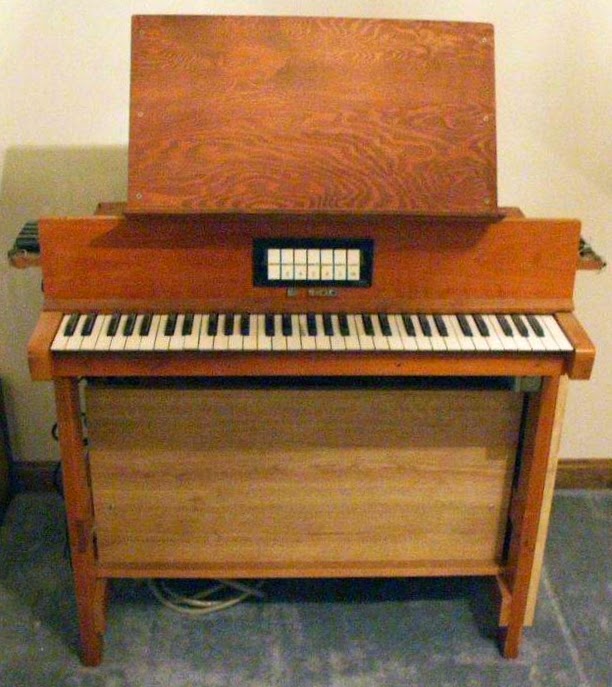
I recently found photographs in my old picture files, having saved them from online when this instrument went up for auction on eBay in 2002 or 2003.  The collection included various views of the chandelier organ, as well as a picture of the small console that was built to play it independently of a main pipe organ.  Doing a bit of research I learned that the instrument I have pictured is now, after restoration by Keith Williams and the service team at Buzard Organ Company, playing as part of a 1968 Wicks Pipe Organ in St. Thomas the Apostle, Catholic Church, Crystal Lake, Illinois. 

The second Möller chandelier organ was recently donated to an exhibit on the Möller Pipe Organ Company at Discovery Station in Hagerstown, Maryland. 

Just a short article on what I think was and is a very cool pipe organ!  Please check out my album of additional photos of the M. P. Möller Organ Company Chandelier Organ