Wednesday, November 26, 2014

Friday, October 31, 2014

Thursday, October 2, 2014
Monday, September 15, 2014
Silent Movie Night! Laurel & Hardy starring in Habeas Corpus


Step back in time as this hilarious silent movie is accompanied by organist Brian Ebie at the organ console of the Suffield United Church of Christ 1115 Ohio 43, Mogadore, OH 44260.
Brian will improvise a movie soundtrack as the film is projected, just like being at a movie theatre in the 1920's!
Habeas Corpus is a short silent comedy film where Laurel and Hardy are hired by a mad scientist to rob a grave. Hilarity ensues, as only Laurel and Hardy can do it, as they sneak into a scary graveyard at night and try to start digging up the dead fellow to bring back to the mad scientist.
Three years ago The Suffield Historical Society watched Lon Cheney's 1927 movie Phantom of the Opera with Brian at the console of his Schantz Pipe Organ.
Laurel & Hardy at the Suffield United Church of Christ will be every bit as fun and exciting! Come and bring a friend! Refreshments to follow. Free and open to the public.
Get ready for Halloween with a funny silent movie!

Friday, September 5, 2014
The M. P. Möller Organ Company Chandelier Pipe Organ

An experimental design of a "chandelier organ" was built by Möller employees to be suspended from a high ceiling and to allow the tone to gently descend on the listeners. In keeping with the tradition of the Echo or Ethereal or even Antiphonal divisions sometimes incorporated into pipe organs, the chandelier organ would have provided a simple flute and principal sound producing tone from a different direction than the main organ.
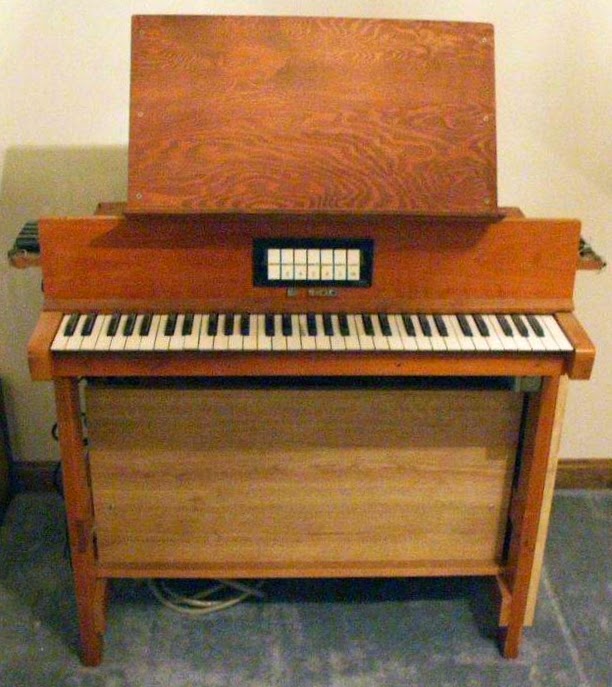
Möller built only two of these instruments.
I recently found photographs in my old picture files, having saved them from online when this instrument went up for auction on eBay in 2002 or 2003. The collection included various views of the chandelier organ, as well as a picture of the small console that was built to play it independently of a main pipe organ. Doing a bit of research I learned that the instrument I have pictured is now, after restoration by Keith Williams and the service team at Buzard Organ Company, playing as part of a 1968 Wicks Pipe Organ in St. Thomas the Apostle, Catholic Church, Crystal Lake, Illinois.
The second Möller chandelier organ was recently donated to an exhibit on the Möller Pipe Organ Company at Discovery Station in Hagerstown, Maryland.
Just a short article on what I think was and is a very cool pipe organ! Please check out my album of additional photos of the M. P. Möller Organ Company Chandelier Organ
Thursday, August 28, 2014
Brian Ebie plays Hogwarts Hymn from Harry Potter and the Goblet of Fire ...
I made a lunchtime visit to the pipe organ I built at Mogadore Christian Church in Mogadore, Ohio. It was a hot summer day, one of the few we've had this year. I decided to record a piece that I have long thought would be great on an organ... Hogwarts Hymn from Harry Potter and the Goblet of Fire. I hope you enjoy it!
Recorded using an iPad, iMovie, and an Apogee MiC 96k.
Special thanks to Laura for editing and making it look great!
Thursday, August 14, 2014
The First Mormon Tabernacle Organist
The First Mormon Tabernacle Organist
By Brian Ebie
Anyone who has traveled to Temple Square in Salt Lake City,
Utah is of course familiar with the famous 206-rank Aeolian Skinner pipe organ
in the Mormon Tabernacle, and perhaps even the 130-rank Schoenstein pipe organ in the LDSConference Center. And while these are
certainly the most famous instruments on Temple Square, there are many other
smaller pipe organs that are used for concert and practice by the Tabernacle
Organists Richard Elliott, Clay Christiansen, and Andrew Unsworth. The Assembly Hall boasts a 65 rank Robert Sipe Tracker, and the Joseph Smith Building a 45 rank Casavant. Additionally, there are three practice organs
located in the offices under the Assembly Hall by Austin, Casavant, and KennethCoulter. Two Dowd Harpsichords and a
continuo organ and some 75 pianos also reside on Temple Square.
But it was a humble reed or “pump” organ, maker unknown,
which traveled across the plains on the Mormon Trail in the year 1862 and often
carried on the back of pioneer John Daynes that would lead to the birth of the
great pipe organ tradition on Temple Square.
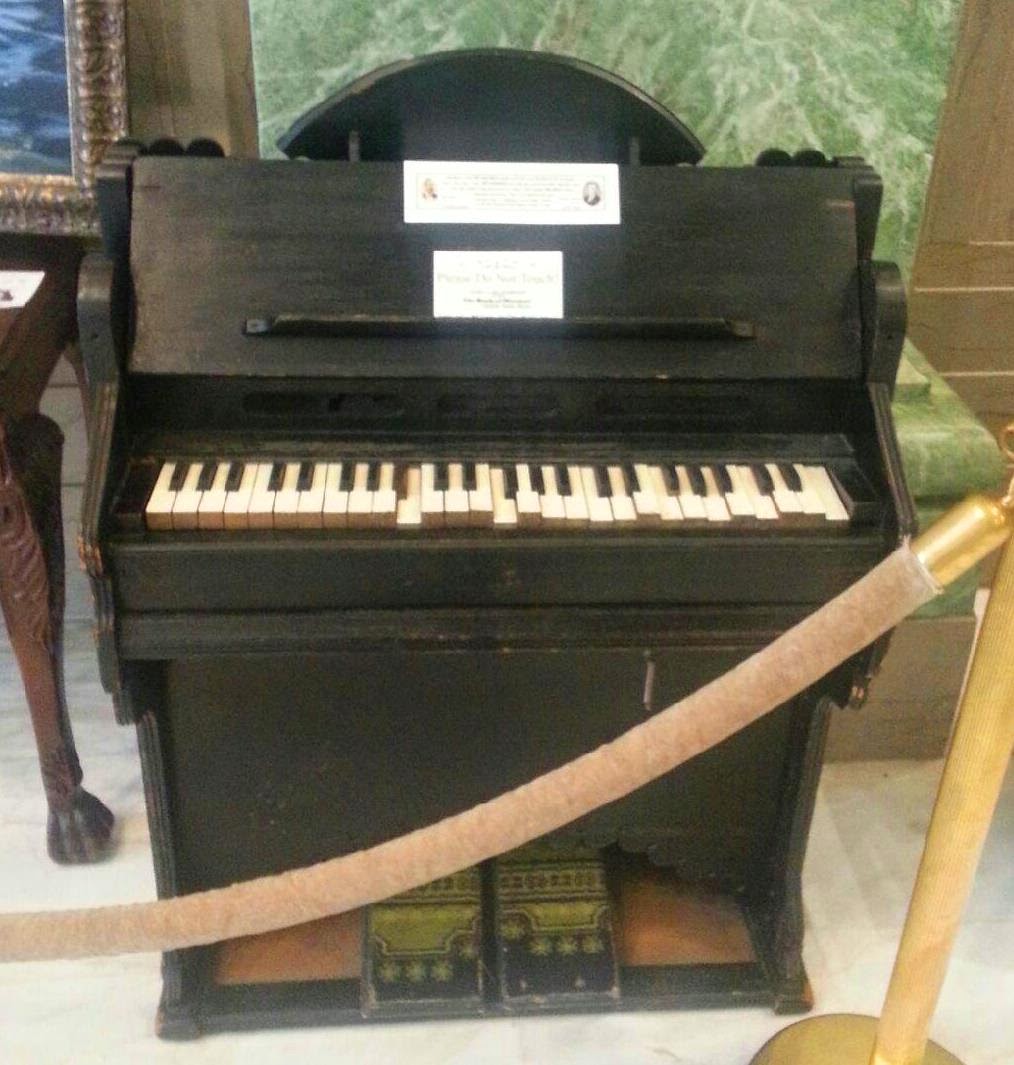 |
The reed organ carried across the plains on the back of John
Daynes,
father of the first Tabernacle Organist, Joseph Daynes.
|
There was much hardship and difficulty, treacherous
conditions, poor weather, sickness and death accompanying the Saints as they
traveled west. Physical exhaustion and
lack of food contributed to terrible conditions along the trail. There was
little else to do but travel by day and sleep by night. But on one particular evening, around a
campfire and circled wagons and handcarts, John Daynes’ young son Joseph played
the little pump organ and entertained the tired travelers with songs and
hymns. Brigham Young, then President of
the Church of Jesus Christ of Latter-day Saints, stopped by the encampment and
noticed the young Joseph and being so taken with the music and the positive
mood it created for the weary pioneers, proclaimed “There is our organist for
the great Tabernacle organ!” Brigham had
often been asked who would play the new organ in the Tabernacle to which he
would reply that the Lord would provide men able to do all things that were necessary.

Young Joseph Daynes
(1851-1920) was sent to New York to study organ and returned to become the
first official Tabernacle Organist. He
was known for his excellent sight-reading, sensitive accompaniment, and
compositions as well as being a proficient organist.
You may even be familiar with his most famous hymn, "As
the Dew from Heaven Distilling," which is the closing hymn for the MormonTabernacle Choir's broadcast each Sunday of “Music and the Spoken Word.”
Subscribe to:
Posts (Atom)