Saturday, December 24, 2016

Tuesday, August 9, 2016
Pipe Organ Removal -- The Hardest Thing about Taking Out a Pipe Organ

Check out my most current blog post on the removal of a wonderful old pipe organ from an old church building. In the coming weeks I'll be blogging both the removal process and the history of this church as the organ goes into a period of hibernation until it's next home can be found.
Excerpt:
The Hardest Thing about Taking Out a Pipe Organ
by Brian EbieI’m not sure what has been the hardest thing about taking out this pipe organ.
A beautiful instrument going silent?
The closing of an historic church?
Experiencing vicariously the loss the congregation must feel?
Figuring out where to store countless pipe organ pieces and parts?
In the early hours of each morning as I’ve worked in the church, walking from balcony to organ chamber and out the door to my truck, my mind replays many happy times as organist at the church as well as the great memories of installing the pipe organ. Twenty four years ago I enlarged the existing pipe organ, barely beefy enough to accompany the hymns, to become a great instrument in worship and recital.
You can read the full post here on my website, http://brianebiepipeorganservice.com
http://brianebiepipeorganservice.com/blog/2016/8/1/the-hardest-thing-about-taking-out-a-pipe-organ
Wednesday, July 27, 2016
Pipe Organ Removal--When churches no longer need the King of Instruments

Check out my most current blog post on the removal of a wonderful old pipe organ from an old church building. In the coming weeks I'll be blogging both the removal process and the history of this church as the organ goes into a period of hibernation until it's next home can be found.
Excerpt:
The Last Songs of an Old Friend -- Pipe Organ Removal
By Brian Ebie
Read the full post here on my website, http://brianebiepipeorganservice.com
http://brianebiepipeorganservice.com/blog/2016/7/19/the-last-songs-of-an-old-friend-pipe-organ-being-removed
Friday, February 19, 2016
Bach Fantasia In C Major BWV 570 -- Brian Ebie Organist
Organist Brian Ebie plays Johann Sebastian Bach's Fantasia in C Major BWV 570 on the 1974 Rudolf JANKE tracker pipe organ at the United Methodist Church of Berea, Ohio. Recorded Ash Wednesday 2016.
The Fantasia in C is an early organ work of JS Bach. It is composed as a standalone piece, not coupled with a fugue or any other movements which is somewhat unusual for Bach, who wrote many preludes and fugues, toccatas and fugues, and fantasias and fugues. That being said, in his earlier years he did compose individual organ works not tied to a larger structure, such as the Fugue in G Minor ("Little Fugue") BWV 578. The Fantasia in C Major (as well as the aforementioned "little" fugue) was written around 1706-07 while Bach was serving as organist in the town of Arnstadt, or during a brief stay in the city Muhlhausen.
I hope you enjoy my impromptu performance on the Janke pipe organ, recorded during the Ash Wednesday services. Thank you for watching!
The Fantasia in C is an early organ work of JS Bach. It is composed as a standalone piece, not coupled with a fugue or any other movements which is somewhat unusual for Bach, who wrote many preludes and fugues, toccatas and fugues, and fantasias and fugues. That being said, in his earlier years he did compose individual organ works not tied to a larger structure, such as the Fugue in G Minor ("Little Fugue") BWV 578. The Fantasia in C Major (as well as the aforementioned "little" fugue) was written around 1706-07 while Bach was serving as organist in the town of Arnstadt, or during a brief stay in the city Muhlhausen.
I hope you enjoy my impromptu performance on the Janke pipe organ, recorded during the Ash Wednesday services. Thank you for watching!
Thursday, November 5, 2015
A Pipe Organ Desk!
I recently created a board on Pinterest called Random Old Organ Pipes.
I got the idea from a picture I'd seen of a birdhouse made out of two old wooden flute pipes. (Whether or not making a birdhouse from an organ pipe qualifies as a travesty is a topic for later discussion...) Well, it's surprising what people have dreamed up. An organ pipe shelf. An organ pipe knife holder. An organ pipe ribbon rack. Organ pipe benches. And my favorite, the aforementioned organ pipe birdhouse.
 But it was the Kagen Sounds pipe organ desk that really grabbed my attention, for, not only is it beautifully crafted desk with organ pipes about; it's also a sort of puzzle! Master wood worker and designer Kagen Sound of Denver, Colorado, has created this pipe organ desk with the most beautiful woods, unparalleled craftsmanship, and intrigue.
Kagen's specialty is secret boxes, and is a recognized member of the world's only guild of secret box makers.
Pipe organs, as we all know, are the epitome of a "secret box" with all of their pipework, windways, windchests, mechanical actions, wiring, and bellows, reservoirs, and blowers. So what a perfect combination, to build an organ that makes noise as one opens and closes the desk drawers.
 Do you remember an episode of Scooby Doo where the team finds a note on an organ that says "FEED the organ and watch the floor?" Its always stuck with me, that Velma (who else?) figured out that FEED meant to play the notes F, E, E, D on the organ. Sure enough a trap door opened in the floor and Shaggy, Scooby, et. al were able to escape.
In much the same way (with apologies to Kagen Sound), the pipe organ desk--when *FED* the appropriate combination of drawers opening and closing--opens up to reveal secret compartments. One can even play tunes and solve more puzzles contained within the larger drawers!


I got the idea from a picture I'd seen of a birdhouse made out of two old wooden flute pipes. (Whether or not making a birdhouse from an organ pipe qualifies as a travesty is a topic for later discussion...) Well, it's surprising what people have dreamed up. An organ pipe shelf. An organ pipe knife holder. An organ pipe ribbon rack. Organ pipe benches. And my favorite, the aforementioned organ pipe birdhouse.
 But it was the Kagen Sounds pipe organ desk that really grabbed my attention, for, not only is it beautifully crafted desk with organ pipes about; it's also a sort of puzzle! Master wood worker and designer Kagen Sound of Denver, Colorado, has created this pipe organ desk with the most beautiful woods, unparalleled craftsmanship, and intrigue.
Kagen's specialty is secret boxes, and is a recognized member of the world's only guild of secret box makers.
Pipe organs, as we all know, are the epitome of a "secret box" with all of their pipework, windways, windchests, mechanical actions, wiring, and bellows, reservoirs, and blowers. So what a perfect combination, to build an organ that makes noise as one opens and closes the desk drawers.
 Do you remember an episode of Scooby Doo where the team finds a note on an organ that says "FEED the organ and watch the floor?" Its always stuck with me, that Velma (who else?) figured out that FEED meant to play the notes F, E, E, D on the organ. Sure enough a trap door opened in the floor and Shaggy, Scooby, et. al were able to escape.
 In much the same way (with apologies to Kagen Sound), the pipe organ desk--when *FED* the appropriate combination of drawers opening and closing--opens up to reveal secret compartments. One can even play tunes and solve more puzzles contained within the larger drawers!

The amazing craftsmanship of the Pipe Organ Desk can be seen in the pictures on the site. I've chosen a few that I found the most fascinating.
"Adjusting these pegs on the back of the memory board changes
the tune it reads. The dark pegs represent the notes of the song." (Picture and Text from Kagen Sound Website)
Wooden air connectors inside the desk. (Picture and Text from Kagen Sound Website)


The pneumatic memory board and organ pipe octave. Each pipe can be adjusted to play any note
within an octave. All organ pipes can be tuned to perfect pitch. (Picture and Text from Kagen Sound Website)
Check out Kagen Sound on the web and see his many beautiful creations, including the Koa Pipe Organ Box.
I'd love to see this in person someday and experience working the puzzles and combinations to make music on the Kagen Sound Pipe Organ Desk! I told my wife that someday I want something like this at home. I suppose that's a.. uh hm, err.. pipe dream.

©2015 Brian Ebie
Friday, September 25, 2015
Recording Edison Cylinders and Diamond Discs --- Just Take Those Old Records off the Shelf, Part 3

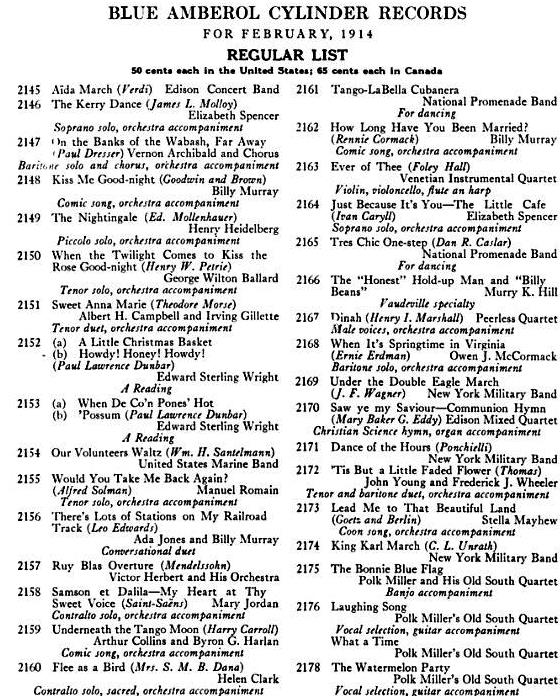
 This week's installment is a February 1914 of My Heart at Thy Sweet Voice, from Camille Saint-Saëns Opera Samson and Delilah, as performed by contralto Mary Jordan (1879-1961). (Samson et Dalila. Mon cœur s'ouvre à ta voix) Cylinder number 2158: Edison Blue Amberol
Something that struck me right away about the recording was that Mary Jordan made the recording while Camille Saint-Saëns (1835-1921) was still living. What an amazing time to be alive. I wonder if he heard it? What must it have been like to hear recordings of your works in the early days of recording?
It is fairly well documented that Thomas Edison did not tolerate vibrato or tremolo either in voice or instrument. This peculiar musical taste of his, it is conjectured, was due to his hearing loss.
Neil Baldwin, in his book, Edison, Inventing the Century, recounts the story of Edison’s dislike of complicated music:
“Edison [was] in the business to find the best mechanical way to “establish music on a scientific basis.” Along with a more finely honed consumer product, he likewise sought to eliminate the intervention of the singer’s dramatic personality, expressed through vocal devices like vibrato; he believed these “false notes” were symptomatic of “interpretative” music and its concomitantly misleading and superfluous nuances and subtleties—which, of course, he could not truly discern or appreciate.
“Instead, Edison sought clear diction, what he called “straight” tone: just plain, unadorned notes.”
When a famous violinist was playing for Edison, the violinist quickly realized the sort of sound Edison was looking for and thus "...he drew a dead sound, the worst kind possible, utterly devoid of vibrato. "That's great! That's great!" Edison said."
True to form, in Mary Jordan's recording of this aria, her vibrato is slow, and the solo violin passages are devoid of any trace of vibrato... just a straight tone.
Not much is known about Mary Jordan, apart from her career with Edison and a note in the Edison Amberol Monthly vol 11 about her headlining at the Century Theatre in New York.
I was able to find this picture of Mary Jordan performing at the Century Theatre:

Also, the pictures below of her name in print in the Edison Amberol Monthly, which was published for sellers of phonographs:

Finally, a picture of her name in print next to the cylinder of "My Heart at Thy Sweet Voice" Edison Cylinder 2158:
My Heart At Thy Sweet Voice Lyrics
My heart at they sweet voice
Swift unfolds like a flower,
When the dawn first is showing.
Swift unfolds like a flower,
When the dawn first is showing.
But Oh! to stop my tears
Thou has it in thy power,
One word more, love be stowing.
Thou has it in thy power,
One word more, love be stowing.
To thy Delilah gay
Thou returnest for alway!
Repeat they wooing tender,
All the vows once more tell;
Those sweet vows lov’d so well!
Thou returnest for alway!
Repeat they wooing tender,
All the vows once more tell;
Those sweet vows lov’d so well!
Chorus
Ah! come list to my fond wooing!
‘Tis with ardor my heart imbuing!
Listen unto my wooing, Listen unto my wooing
Ah! ‘Tis with ardor my heart imbuing!
‘Tis with ardor my heart imbuing!
Listen unto my wooing, Listen unto my wooing
Ah! ‘Tis with ardor my heart imbuing!
Mon cœur s'ouvre à ta voix
Mon cœur s'ouvre à ta voix,
comme s'ouvrent les fleurs
aux baisers de l'aurore!
Mais, ô mon bienaimé,
pour mieux sécher mes pleurs,
que ta voix parle encore!
Dis-moi qu'à Dalila
tu reviens pour jamais.
Redis à ma tendresse
les serments d'autrefois,
ces serments que j'aimais!
|: Ah! réponds à ma tendresse!
Verse-moi, verse-moi l'ivresse! :
comme s'ouvrent les fleurs
aux baisers de l'aurore!
Mais, ô mon bienaimé,
pour mieux sécher mes pleurs,
que ta voix parle encore!
Dis-moi qu'à Dalila
tu reviens pour jamais.
Redis à ma tendresse
les serments d'autrefois,
ces serments que j'aimais!
|: Ah! réponds à ma tendresse!
Verse-moi, verse-moi l'ivresse! :
Ainsi qu'on voit des blés
les épis onduler
sous la brise légère,
ainsi frémit mon coeur,
prêt à se consoler,
à ta voix qui m'est chère!
La flèche est moins rapide
à porter le trépas,
que ne l'est ton amante
à voler dans tes bras!
|: Ah! réponds à ma tendresse!
Verse-moi, verse-moi l'ivresse!
les épis onduler
sous la brise légère,
ainsi frémit mon coeur,
prêt à se consoler,
à ta voix qui m'est chère!
La flèche est moins rapide
à porter le trépas,
que ne l'est ton amante
à voler dans tes bras!
|: Ah! réponds à ma tendresse!
Verse-moi, verse-moi l'ivresse!
Monday, August 24, 2015
Recording Edison Cylinders and Diamond Discs --- Just Take Those Old Records off the Shelf, Part 2

Announcer:
Thomas A. Edison, the inventor of the phonograph, has never before permitted his voice to be recorded for the public. Today, however, he has a message for you that is important enough to cause him to break his long established rule. Mr. Edison will now give you that message. I beg to introduce Mr. Thomas A. Edison:
Thomas Alva Edison:
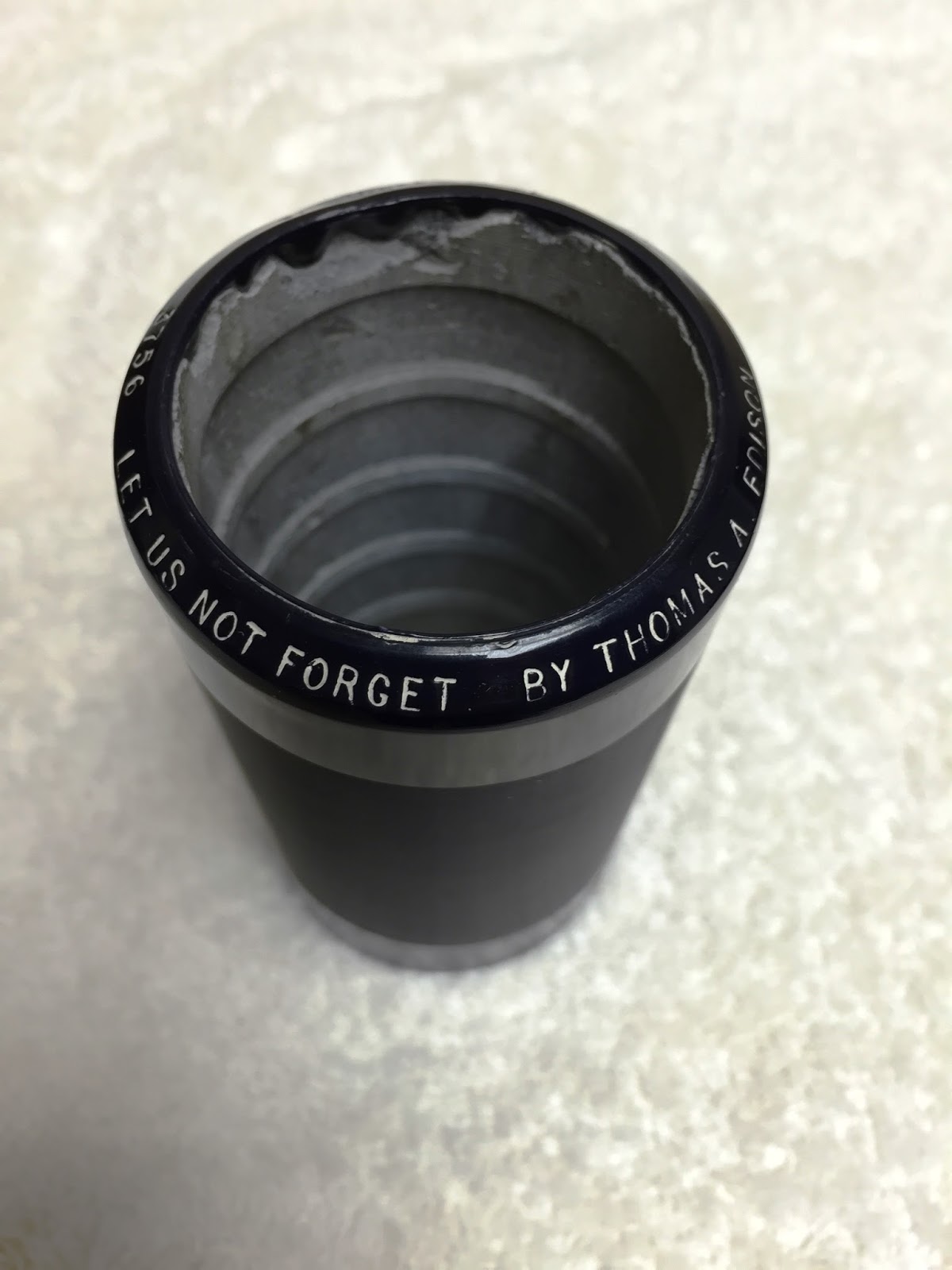 |
| Thomas Edison's Address "Let Us Not Forget" 1919 |
Thanks for reading, and I hope you enjoy this cylinder recording.
Subscribe to:
Posts (Atom)